
Why I built it
I’ve spent nearly nine years building things at work and had nothing of my own to show for it. No side projects that shipped, no writing. Just a resume.
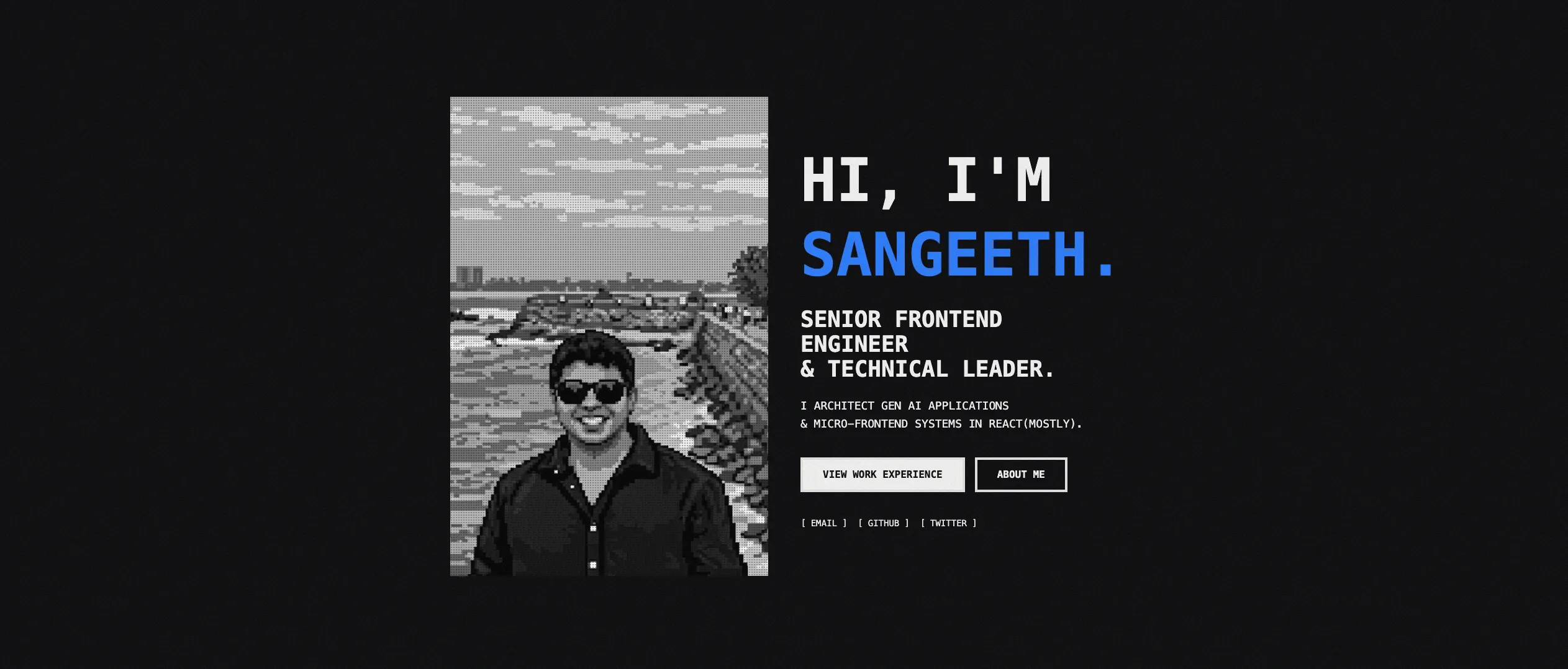
The first version went up in January 2026: dark, brutalist, monospace everywhere. You can still visit it. What you’re looking at now is version two.
Two versions of every page
Every page now exists twice. The quiet version is watercolor and paper, a serif typeface, and small Tamil and Japanese touches like the red seals. The loud version is monospace, stickers, stencils and a bit of glitch. Each one has a light and a dark mode.
The first time you visit, you pick one. “Turn it up” and “turn it down” in the header switch between them whenever you like, and the site remembers your choice.
Both versions are in the HTML of every page. One attribute on the page decides which one shows, so switching doesn’t reload or re-render anything. It just swaps.
It makes sound, if you let it
The quiet side is built around the Carnatic scale, ச ரி க ம ப த நி ச. Each letter of my name is a note, and hovering or scrolling past them plays the scale. The three cats on the about page each play a note too. The loud side has pads to play instead.
Sound is off until you turn it on. Turning it on plays one tanpura strum, and after that only what you touch makes a sound. Nothing loops in the background.
There’s a hidden track on each side. I’m not going to say how to find them, except that one of them involves playing something backwards.
Keeping it fast
The watercolor was the hard part. It started as live SVG filters, and those looked right but stuttered in Firefox and Safari, which draw filters on the CPU. Every section that scrolled into view dropped frames.
So the big washes are now baked. A script renders each shape once into a small mask image, and CSS colors it with the theme tokens, so it still changes with light and dark mode. The paper grain is a baked tile too. Anything that moves gets its own layer so the browser doesn’t repaint the filters underneath it. And everything respects reduced motion.
How it’s put together
Astro 5, TypeScript, Tailwind CSS 4 and MDX, hosted on Cloudflare Pages. There’s no UI framework in the browser. The interactive parts are small TypeScript modules.
Most of the words on the site live in MDX files, including the home and about pages, so changing copy rarely means opening a component. The link previews are drawn at build time too, one card per page, quiet on the left and loud on the right.
The writeup on how version one was built covers the Astro basics.