After 8+ years in software engineering, I’m finally starting a blog. I didn’t suddenly become a better writer (I haven’t). The things that kept me from blogging just stopped being in the way.
Who I am
I’m Sangeeth Sivan. I lead frontend engineering for two teams at Demandbase. Most of my work is in:
- Frontend architecture and technical leadership
- GenAI-powered user interfaces
- Micro-frontend architectures
- React and the tooling around it
You can read more about me or connect with me on LinkedIn, GitHub, or X.
No visible work
I’ve spent my whole career building things at work, and I have nothing to show for it publicly.
8+ years of engineering:
- GenAI applications at Demandbase
- Enterprise features at Appsmith
- Micro-frontend architectures
- Internal SDKs and tooling
Publicly visible work:
- (crickets)
When you apply for a new job, a strong resume isn’t enough anymore. Hiring managers want to see GitHub activity, personal projects and some writing that shows how you think.
I had none of that. Just a resume.
Why I never blogged before
Writing is exhausting
I’m not a natural writer. I do write a lot at work: architecture docs, design guides, specs, decision records. That writing gets done because someone needs the doc and my team depends on it, so I push through.
Outside work, no one’s waiting for my words. No deadline, no one depending on it. That killed my motivation. Organizing my thoughts into sentences felt pointless when it was just for me, and after a day of writing code, writing prose for nobody was the last thing I wanted to do.
Perfectionism
I’d start a blog post, get halfway through, decide it wasn’t good enough, and abandon it. Repeat for years.
A perfect post that never gets published is worth nothing.
Unfinished projects
Blogging is easier when you have finished projects to write about. I’ve started dozens of personal projects over the years and never shipped one.
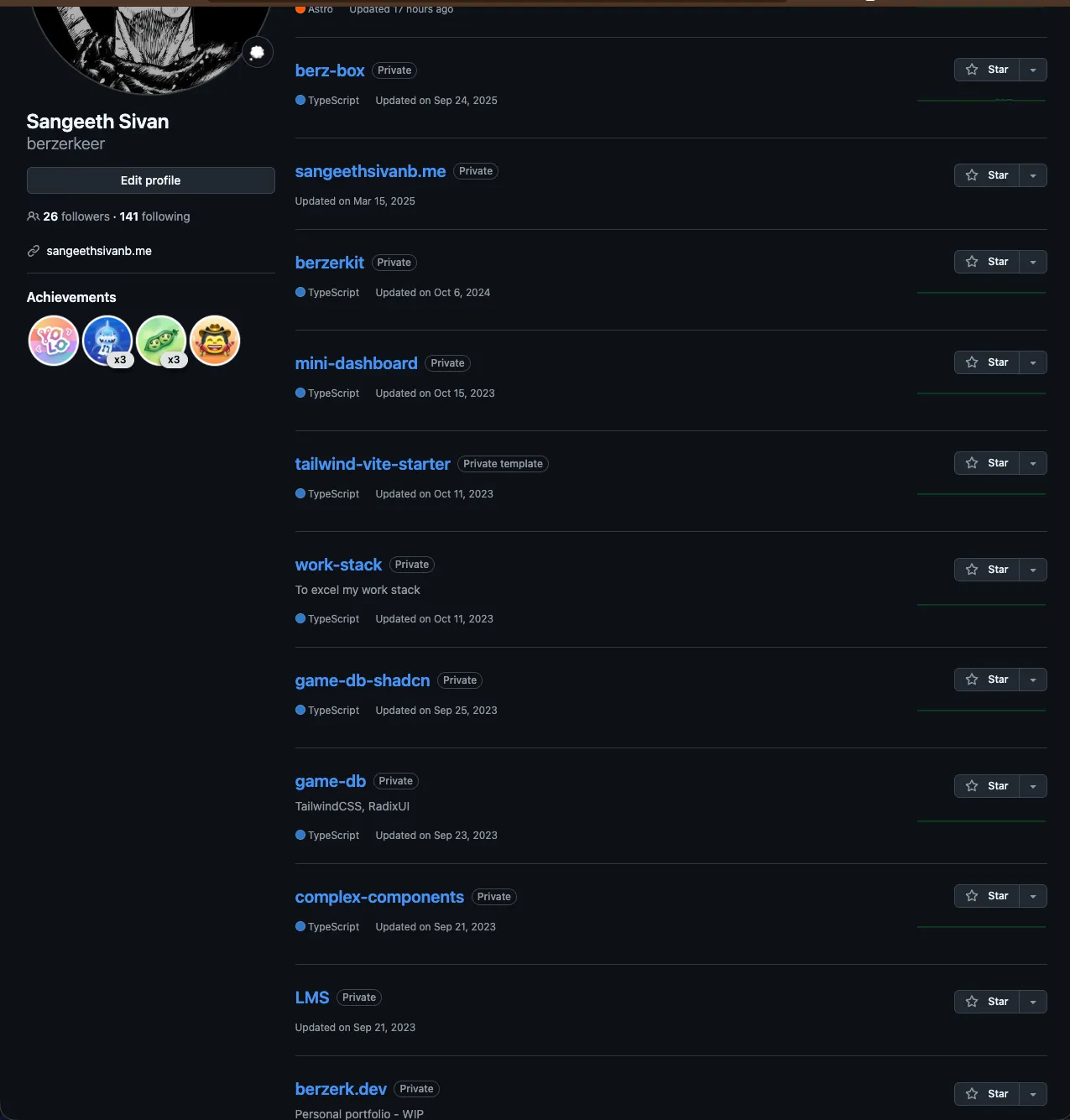
The pattern is always the same: I get excited, code furiously for a few weeks, hit the halfway point, then life happens. Work gets busy. Friends want to hang out. I just want to sit at home and play video games or do nothing. And the project gets abandoned.
That was the real blocker. Outside work I had other priorities: gaming, friends, just existing. I wouldn’t trade those for more side projects. But it meant my side projects never made it past the halfway point.
This portfolio site is the first personal project I’ve finished and shipped. That’s a big deal for me.
Procrastination
It’s easier to read other people’s posts than write your own. I kept telling myself I’d start tomorrow, then the next day, then the next.
I procrastinated for years.
What changed
AI as an editor
I don’t use AI to think for me, and I don’t ask it to write posts on a topic. I write a draft about something I built: broken grammar, typos, awkward phrasing and all. Then I use AI as an editor to make it clearer.
My workflow now:
- I write the draft myself: the ideas, the structure, the examples.
- AI fixes grammar and simplifies sentences.
- I go through the changes, keep what works and throw out what doesn’t.
- I publish it.
Thinking, organizing ideas and finding the right examples are the parts that improve with practice, and those stay mine. AI does a lot of the work of turning a rough draft into something publishable, and without that I’d never have started this blog.
There’s a side effect too. Seeing what the editor changes in every draft is teaching me what good writing looks like.
Making it stick
AI makes writing easier. It doesn’t make me want to do it. What changed this year was a promise to myself to finish something. Starting 2026 with the goal of shipping things, projects or posts, feels different.
Proof of work
Tech jobs change. Companies restructure and roles move around. If I ever need to look for a new job, I want a portfolio, a few posts and some projects that show what I can do.
There’s another reason. A lot of companies I apply to ask LeetCode-style coding questions, and I’m terrible at them. I freeze up. Can’t think under pressure. Put me on a real project with real constraints and real users, and I do well. Building products, shipping features, chasing edge cases and performance problems: that’s what I’m good at.
I can use algorithms when a project needs them. If a project requires optimization or a specific data structure, I’ll research it, understand the trade-offs, and implement it. That’s normal engineering work. But memorizing obscure algorithms for a 45-minute interview? That’s a different skill entirely, and not one I’m good at.
A site with real projects I’ve shipped shows something LeetCode can’t: that I can build things that work and finish them. That’s closer to the day-to-day job than a timed puzzle.
What I’ll write about
Work projects, with the private parts removed
I can’t share proprietary code or internal details, but I can write about:
- Architecture decisions and their trade-offs
- Problems I ran into and how we got past them
- Patterns that worked, and ones that didn’t
Personal projects
Starting with this site. I wrote up how it’s built, and it has its own project page.
More will follow: small tools, experiments, and side projects for problems I actually have.
Technical deep dives
How a framework or pattern works under the hood, comparisons between approaches, and performance work.
Career and learning
What I’m learning about leading engineers: making technical decisions, onboarding people, writing docs, and when to build versus buy.
The point
Build things, write about them, repeat.
I’m not trying to be a tech influencer. No quotas, no growth metrics. Just projects that ship and posts that explain what I learned.
A public record of my work helps when someone wants to know what I can do. It’s also personal documentation. In six months, I won’t remember why I chose approach X over Y, or what problems I ran into when building feature Z. The blog becomes my notes, so I don’t have to relearn it all later.
Starting
The posts won’t be perfect. Some will be long and technical, some short. But they’ll be published, which is more than my old drafts managed.
If you’re reading this and thinking you should start a blog too, pick a framework and publish one post. You can fix it later.
The title comes from Andrew Borstein’s post of the same name. When I sat down to write my first post, his title already said it.